Behind the Rescue: Why Houndstooth and Cannoli's Return Matters
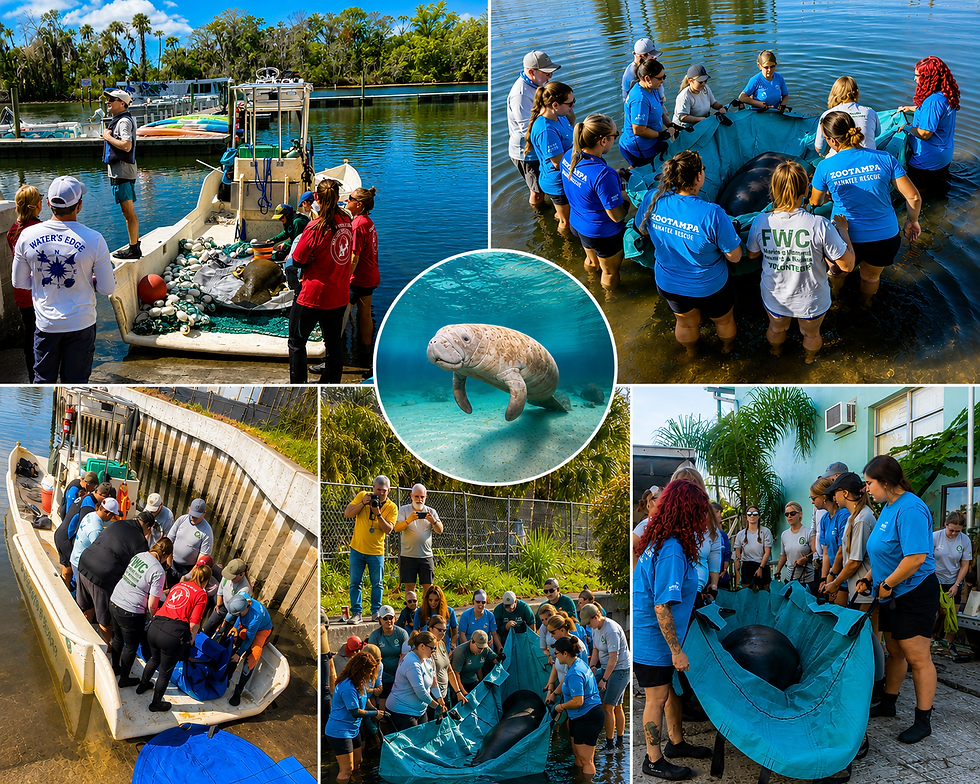
The journey from rescue and rehabilitation to a return home in Crystal River.
When two rehabilitated manatees named Houndstooth and Cannoli were released back into Kings Bay, most people saw a heartwarming conservation success story.
What many people don't see is the network of wildlife professionals, researchers, rehabilitation facilities, volunteers, and conservation partners working together to make releases like this possible.
Houndstooth was rescued in January after being found weak and underweight in Crystal River. A few weeks later, Cannoli was rescued from the same area under similar circumstances. After receiving rehabilitation care at SeaWorld Orlando, both manatees recovered and were eventually released back into Kings Bay.
Their story highlights something much larger than the recovery of two individual animals—it highlights the ongoing effort to protect Florida's manatee population and the critical role Crystal River plays in that mission.
Why Crystal River Is So Important
Crystal River and Kings Bay are among the most important manatee habitats in Florida.
Unlike many waterways that fluctuate significantly throughout the year, the springs that feed Kings Bay maintain relatively stable temperatures. These spring systems provide warm-water refuge for manatees during colder months when survival can depend on finding water that remains warm enough to avoid cold stress.
Because of these natural conditions, thousands of manatees visit the Crystal River area each winter. For many animals, the springs are not simply a convenient stop—they are essential habitat.
Scientists and wildlife managers consider Florida's natural springs increasingly important to the future of manatee conservation.
From Rescue to Rehabilitation
When a manatee is found sick, injured, or unable to thrive in the wild, wildlife professionals evaluate whether intervention is necessary.
If rehabilitation is required, the animal is transported to a facility capable of providing specialized veterinary care and long-term monitoring.
The goal is simple: return the manatee to a condition where it can survive successfully in the wild.
Rehabilitation may involve medical treatment, nutritional support, monitoring, and ongoing evaluation of the animal's health and behavior.
Only after experts determine the animal is ready are plans made for release back into suitable habitat.
For Houndstooth and Cannoli, that process resulted in significant gains in size and body condition before their return to Kings Bay.
Understanding Where Manatees Go
Returning a rehabilitated manatee to the wild is not the end of the conservation story.
Researchers continue studying how manatees use Florida's waterways, which habitats they depend on, and how environmental changes may affect their future.
One important research tool is radio telemetry and tracking technology. Scientists use tracking programs to better understand migration patterns, habitat use, seasonal movement, and behavior. The information collected helps wildlife managers make informed decisions about habitat protection and conservation planning.
Research also helps identify which habitats are most important and how those habitats may need to be protected in the future.
As Florida continues to grow and change, understanding how manatees interact with their environment remains a critical part of conservation efforts.
A Conservation Success Story
Every healthy manatee swimming through Kings Bay represents years of scientific research, habitat protection, rescue coordination, veterinary care, and public support.
The successful return of Houndstooth and Cannoli is a reminder that conservation is often a team effort involving many organizations and individuals working toward the same goal.
For visitors paddling through the springs or residents who see manatees every day, these animals are a cherished part of life on the Nature Coast. Their recovery and release demonstrate how collaboration can help ensure future generations continue to experience manatees in the wild.
Houndstooth and Cannoli by the Numbers
Houndstooth
Rescued in January in Crystal River
Found weak and underweight
Rescue Length: 10.2 ft
Release Length: 10.6 ft
Release Weight: 1,340 lbs
Cannoli
Rescued in February in Crystal River
Found weak and underweight
Rescue Length: 7.4 ft
Release Length: 8 ft
Release Weight: 745 lbs
Sources & Further Reading
Information for this article was compiled from the following organizations and resources:
Florida Fish and Wildlife Conservation Commission (FWC)
Manatee Release Announcement: Houndstooth and Cannoli Return to Kings Bayhttps://www.facebook.com/share/p/1BRDA3MPdV/
Florida Fish and Wildlife Conservation Commission (FWC)
Radio Telemetry & Manatee Tracking Researchhttps://myfwc.com/research/manatee/research/radiotelemetry-tracking/process/
Clearwater Marine Aquarium Research Institute
Manatee Research & Conservation Programshttps://mission.cmaquarium.org/research-institute/manatee-research/
About Water's Edge Insider
Water's Edge Insider is an independent local publication focused on wildlife, conservation, outdoor recreation, tourism, and life on Florida's Nature Coast. Our goal is to educate readers while highlighting the people, places, and conservation efforts that make Crystal River and Kings Bay unique.
Report an Injured, Sick, or Distressed Manatee
FWC Wildlife Alert Hotline888-404-3922
This format feels more like a magazine or newspaper citation page rather than an academic bibliography, which fits the style you're building for Water's Edge Insider.


Comments